Liquidation heatmap
A map of the price levels where forced liquidations would land, drawn in color. Thick clusters often act like a magnet, pulling price toward them.
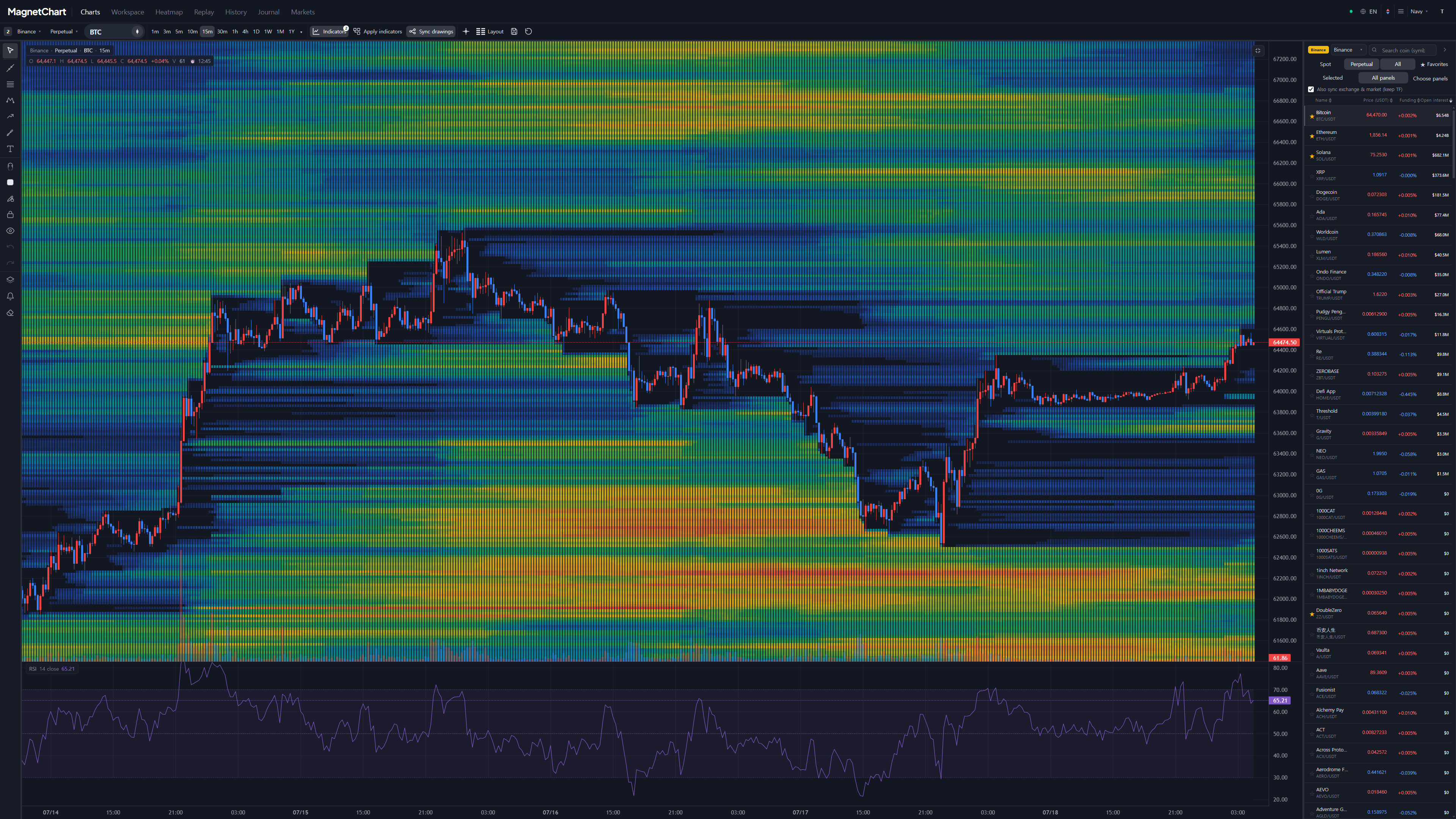
How it is built
We record open interest changes and print flow every minute, estimate the distribution of entry prices and leverage, and spread that across the price levels where those positions would be liquidated. Binance, Bybit, OKX and Bitget are aggregated, so it reflects market-wide pressure rather than one venue. The estimate keeps updating as new prints and open interest arrive, and levels decay once they have been cleared.
How to read it
The brighter and denser a band, the more liquidation size is estimated to sit at that price. Bands above the current price are short liquidations; bands below are long liquidations. A thick band cuts both ways. Price reaching it can cascade through and accelerate, or it can absorb the flow and reverse. Do not trade a band on its own — read it together with book liquidity and print flow.
What it is based on
Only public exchange API data: open interest, trades and order books. No individual position data and no exchange-internal data is used, nor could it be. This heatmap is therefore an estimated distribution built from public data, not a real liquidation order book.
Access
The liquidation heatmap is a Pro feature. Signing up gives you seven days of Pro without a card, which opens the heatmap along with every other analysis panel.
Frequently asked
- What is a liquidation heatmap?
- A chart that estimates the price levels where leveraged positions would be force-closed and shades them by size, so clustered liquidation levels are visible at a glance.
- Which exchanges does it cover?
- Perpetual data from Binance, Bybit, OKX and Bitget is aggregated, which tracks market-wide pressure more closely than any single venue.
- Are these real liquidation orders?
- No. Exchanges do not publish individual positions. This is a distribution estimated from public open interest and print flow, and should be treated as a reference signal.